
Between the latest Federal Budget updates and the persistent cost of living headlines on the news, there is a palpable sense of hesitation in the air. I am seeing it in the boardrooms along St Georges Terrace and in the small workshops in Osborne Park. Business owners are looking at their spreadsheets, seeing the squeeze on margins, and reaching for the pause button on their marketing spend.
It feels like the safe thing to do. When the wind picks up and the clouds get dark, the instinct is to pull the sails in. But here is the brutal truth: cutting your marketing spend during a downturn is the single most expensive mistake you will ever make. Retreating now is essentially handing your market share to your competitors on a silver platter.
What is a Recession-Proof Marketing Strategy?
A recession-proof marketing strategy is a set of marketing activities and allocation principles designed to maintain or grow market share during economic volatility. It is not about spending more money recklessly. It is about strategic reallocation and capitalising on a quieter marketplace.
In marketing terms, we talk about Share of Voice (SOV) and Share of Market (SOM). Historically, when your competitors stop advertising, the noise in your industry drops. If you maintain your spend while others quit, your Share of Voice increases automatically without you spending an extra cent. There is a direct, proven correlation between an "Excess Share of Voice" during a downturn and a massive jump in market share when the economy inevitably bounces back.
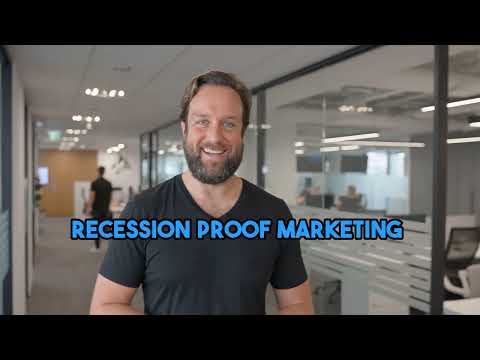
The Psychology of the Modern Buyer in 2026
We have to understand the human element. When the headlines turn negative, the buyer does not necessarily stop spending, but they do stop "guessing." They become hyper-rational. They move away from impulse and towards research. They are looking for "certainty of outcome."
If you are a professional services firm or a local trade, your customers are currently looking for the "safe bet." If you go silent now, you are telling the market that you are either struggling or that you do not have the confidence to stand by your value. Silence is not neutral; silence is a signal of weakness in a tightening market.
Silence is not neutral. In a tightening market, silence is a signal of weakness, and your competitors are listening.
The Cost of Silence: Why Going Dark is Deadly
When you stop marketing, you do not just stop getting new leads today. You break the "mental availability" you have spent years building in the minds of your customers. Marketing is like a flywheel. It takes a massive amount of energy and capital to get it spinning. Once it is spinning, it only takes a small, consistent amount of effort to keep it going.
If you stop entirely, that flywheel grinds to a halt. When you decide to "restart" in twelve months when things look better, you will have to spend three times as much money just to get back to the baseline where you are today. While you were silent, your competitors were busy building trust with your disillusioned former customers.
The Pareto Angle: Doubling Down on the 20%
The mistake most people make is "across the board" cuts. They tell their marketing manager to cut the whole budget by 30 percent. That is lazy leadership. Instead, you need to perform a brutal audit of your activities using the Pareto Principle - the 80/20 rule.
Identify the 20 percent of your marketing activities that are responsible for 80 percent of your high-quality leads and actual revenue. In a tightening market, this usually means moving away from "awareness" fluff and doubling down on high-intent search and existing customer retention. If you have a Google Ads campaign that is consistently bringing in quotes for your manufacturing plant, you do not cut that. You actually consider increasing it because your competitors are likely pulling out of the auction, which often leads to a lower Cost Per Click.
The 5-Step Recession-Proof Playbook
1. The Brutal Audit (Conversion Rate Optimisation)
Before you spend another dollar on traffic, look at your conversion rate. If your website is slow or your follow-up process is sluggish, you are throwing money away. A fast, human response to an enquiry is your biggest competitive advantage when customers are being more selective. Make sure your "bottom of the funnel" is airtight.
2. Re-evaluate Your Value Proposition
The things people cared about two years ago are not the things they care about now. In a boom, people pay for convenience and status. In a squeeze, they pay for reliability, longevity, and "certainty of outcome." Shift your messaging from "the latest and greatest" to "the smartest investment for the long term." Talk about ROI, talk about durability, and talk about reliability.
This shift is not just verbal. Buyers under pressure read trust signals before they read words, and visual credibility carries more weight than ever. A polished website hero shot, a real headshot, an authentic photo of your team or premises - these read as "established and reliable" in a market full of cheap stock imagery and AI slop. Investing in a professional Commercial Photographer Perth shoot during a downturn is one of the highest-leverage trust plays a serious business can make.
3. Own the High-Intent Search (SEO and SEM)
If people are still searching for your service on Google during a downturn, they have a genuine, urgent need. This is not the time for vague brand advertising. This is the time to own the search results for keywords that indicate someone is ready to buy right now. Focus on the "money" keywords where the intent is clear. A specialist SEO Perth strategy is built around exactly this: mapping commercial intent to the right pages and defending the auctions your competitors are abandoning.
4. The Retention Engine (LTV)
It is five to seven times cheaper to sell to an existing client than to find a new one. A recession is the time to go deep with your "inner circle." Create exclusive offers, check-in calls, or value-add services that keep them locked into your ecosystem. Your database is a goldmine that most businesses ignore.
5. Winning the Generative Engine Optimisation (GEO) Battle
As AI tools become the first port of call for research, your brand needs to be cited as an authority. This means producing high-quality, semantically rich content that answers specific, complex questions about your industry. If the AI does not know you exist, the modern researcher will not either.
Not sure which 20% of your marketing is actually working?
A 60-minute paid strategy session to uncover your biggest digital growth opportunities. Walk away with clear, actionable steps to improve marketing performance through the squeeze. Investment: $175 + GST. No payment, no booking. Serious strategy only.
Book Your Diagnostic SessionCase Study: The Osborne Park Logistics Firm
Let us look at a real-world scenario. Imagine a logistics and transport company based in Osborne Park. They have been running Google Ads and doing some light social media. As the economic squeeze hits, their first instinct is to cut their $4,000 monthly marketing spend.
The "Old Way" of reacting would be to cut the budget and wait for the phone to ring. The result? Their competitors, who stayed active, slowly started appearing at the top of the search results for "container transport Perth." By the time the logistics firm wanted to "restart," they had lost their ranking and their cost per lead had doubled.
Grew revenue 20% while the industry contracted.
Instead of cutting blindly, they performed a Pareto audit. They found that their general awareness Facebook ads were doing nothing, but their specific Google Search ads for "interstate freight quotes" were driving 90 percent of their new business. They cut the Facebook spend and moved that money into a deep-dive SEO strategy.
They started producing content specifically for business owners about navigating supply chain costs in 2026. They became the helpful expert while everyone else was silent. Because they stayed visible, they picked up three major new contracts from a rival firm that had gone dark.
By the time the economy settled, they had grown their revenue by 20 percent while their industry average was down. Less money. Smarter allocation. Higher leverage.
The market share land grab happens during the chaos, not during the calm. Fortune favours the consistent.
Common Objections: Addressing the Fear
"I just do not have the cash flow right now."
If it is a choice between marketing and paying your staff, pay your staff. But most cuts are not about survival, they are about fear. If you cannot spend money, spend time. Write the articles, record the videos, and talk to your customers. Sweat equity is a valid marketing currency in a recession.
"Nobody is buying anyway."
That is rarely true. People are still buying, they are just being more deliberate. They are researching more. If you are not in the conversation during their research phase, you will not be there when they finally pull the trigger. You are essentially letting your competitors have a free run at your customers.
"I will wait until things normalise before I start again."
By the time things feel safe, the window of opportunity for cheap attention and easy market share gains will have closed. The market share land grab happens during the chaos, not during the calm. Fortune favours the consistent.
Why Information Gain is Your Secret Weapon
In 2026, Google and AI models are looking for "information gain." This means they want to see content that provides unique, first-hand experience rather than just regurgitating what is already online. Talk about the specific challenges of your local market. Talk about the logistics of your specific industry. This "specialised expertise" is exactly what helps you rank and get cited by LLMs.
If you are a Perth professional services firm, write about the regulatory quirks of WA. If you are a Mandurah trade business, document the seasonal patterns you actually see in your booking calendar. The 80 percent of generic recession content already exists. Your 20 percent of locally specific, first-hand observation is what gets cited and ranked.
The Implementation Checklist: Your Next 30 Days
Days 1-7: Run the Brutal Audit
List every marketing line item from the last six months. Connect each one to actual revenue, not vanity metrics. Use the 80/20 rule to identify the 20 percent of activities driving the bulk of qualified leads.
Days 8-14: Fix the Funnel Before the Top
Review your website conversion rate, page speed, and enquiry response time. A leaky funnel wastes every dollar of traffic spend. Fix the slow loading times and the confusing contact forms before reallocating budget.
Days 15-21: Update the Value Proposition
Rewrite your homepage hero, your service pages, and your ad copy to address the current economic reality. Emphasise reliability, ROI, and certainty of outcome rather than "innovation" or "cutting edge."
Days 22-30: Start the Helpful Expert Campaign
Pick the top ten questions your customers are asking right now and answer them in long-form content. This is your GEO play. While competitors go silent, you become the cited authority.
Ongoing: Activate the Retention Engine
Pull your existing client list. Schedule check-in calls, send a value-add resource, propose an exclusive offer. Selling to existing clients is five to seven times cheaper than acquiring new ones, and recessions are when retention pays the most.
Ongoing: Defend the Money Keywords
Keep your Google Ads bids on high-intent commercial keywords. As competitors withdraw from auctions, your CPCs often drop. This is the moment to defend (and expand) your share of high-intent search.
Final Thoughts on Marketing Through the Squeeze
The most successful companies were not built by following the herd. They were built by staying the course when everyone else panicked. The Federal Budget will come and go. The headlines will cycle. The cost of living debate will continue. None of that changes the fundamental physics of marketing momentum.
Audit your spend. Find your 20 percent. Cut the rest without guilt. Keep your message in front of the people who need you. That is how you market smarter through a downturn, and that is how you come out the other side with more market share than you started with.
Build a recession-proof marketing operation.
All Marketing is a boutique consultancy built for owners who want to grow market share through the squeeze rather than retreat from it. From conversion-focused Website Design Perth through to defending your high-intent search auctions, the focus is the 20 percent that actually moves revenue. The 60-minute Marketing Growth Diagnostic Session ($175 + GST) is the right next step.
Book Your Diagnostic Session